

SpiderGuard
please send us an email to :
Product description


Targeted crops
- Greenhouse vegetable crops
- Strawberry and other berry crops
- Ornamental and flowering plants
- Cannabis production
- Nursery and container crops
- Indoor growing systems
- Other crops susceptible to spider mite damage

Targeted pests
- Two-spotted spider mite (Tetranychus urticae)
- Spruce spider mite (Oligonychus ununguis)
- European red mite (Panonychus ulmi)
- McDaniel spider mite (Tetranychus mcdanieli)
- Carmine spider mite (Tetranychus cinnabarinus)
- Strawberry spider mite (Tetranychus turkestani)
- Banks grass mite (Oligonychus pratensis)
- Southern red mite (Oligonychus ilicis)
- Bamboo mite (Schizotetranychus celarius)
- Other susceptible tetranychid mite species

Application Instructions
Before application, gently rotate the bottle to evenly distribute the predatory mites throughout the carrier material.
Preventive programs, distribute the product evenly across the crop to support establishment and continued predator coverage.
Curative programs, concentrate releases on infested plants, active spider mite hot spots, and the surrounding plants at risk of infestation. Apply directly onto the foliage and distribute the product carefully throughout the treated area.
Continue regular scouting after each introduction and repeat applications according to the recomm
Avoid applying incompatible pesticides before or after releasing SpiderGuard. Always verify pesticide compatibility as part of your IPM program.

Storage Instructions
- For best results, use the product as soon as possible after delivery
- Keep away from direct sunlight and extreme temperatures
- Do not freeze
Understanding How SpiderGuard Works
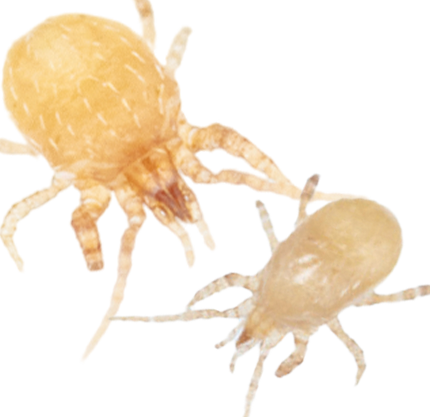
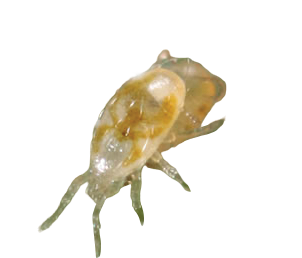
Anatis SpiderGuard is used for the biological control of spider mites. Each ready-to-use blend combines two complementary predatory mite species to support control across different pest pressure levels and growing conditions.
The two species provide complementary activity. One predator helps support continued activity under lower spider mite pressure or specific environmental conditions, while Phytoseiulus persimilis responds strongly to active spider mite colonies and hot spots.
Yes. Each SpiderGuard blend combines an adaptable Neoseiulus species that supports preventive establishment and continued crop coverage with Phytoseiulus persimilis, which provides rapid suppression of established spider mite colonies and hot spots. Use the preventive or curative introduction rate according to pest pressure and scouting results.
The appropriate blend, introduction rate, and frequency will depend on the spider mite species and level of infestation.
The predatory mites in SpiderGuard feed on multiple spider mite life stages, including eggs and immature stages. Phytoseiulus persimilis also actively feeds on mobile spider mite stages within established colonies.
Choosing the Right SpiderGuard Blend
SpiderGuard Flex combines Neoseiulus californicus with Phytoseiulus persimilis and is designed for warm, dry, or variable growing conditions.
SpiderGuard Ace combines Neoseiulus fallacis with Phytoseiulus persimilis. It is designed for production systems where pesticides are used more frequently, particularly in ornamental crops, as N. fallacis offers greater tolerance to several commonly used pesticides.
Choose SpiderGuard Flex for warm, dry, or variable conditions and programs targeting two-spotted spider mite and other susceptible Tetranychus species.
Choose SpiderGuard Ace for IPM programs that include more frequent applications of compatible pesticides, particularly in ornamental crops.
If the spider mite species is unknown, contact Anatis or submit a sample to the Anatis Applied Taxonomic Lab before selecting a blend.
Spider mite species can be difficult to distinguish visually, and incorrect identification may reduce the effectiveness of a biological control program.
Submit a sample to the Anatis Applied Taxonomic Lab for species-level identification and assistance selecting the appropriate predatory mites.
Application and Monitoring
Apply SpiderGuard directly onto foliage, concentrating releases on infested plants, active hot spots, and surrounding plants at risk of infestation.
Distribute the product throughout the treated area to support predator movement and improve crop coverage.
Continue scouting treated plants and monitoring spider mite populations after release. Signs of activity may include predatory mites near spider mite colonies, fewer live spider mites, reduced egg production, and a gradual decline in new plant damage.
Compatibility and Predator Interactions
Yes. SpiderGuard can be integrated with compatible biological control agents such as Stethorus punctillum and other predators as part of a complete spider mite IPM program.
Some pesticides can harm predatory mites or leave residues that reduce their survival. SpiderGuard Ace may be better suited to IPM programs where compatible pesticides are used more frequently, as Neoseiulus fallacis offers greater tolerance to several commonly used pesticides.
However, pesticide compatibility varies depending on the active ingredient, application rate, timing, and residual activity. Always verify compatibility and observe the recommended waiting period before releasing SpiderGuard.

Description
Complementary Predatory Mite Blends for Spider Mite Management
Anatis SpiderGuard™ is a line of ready-to-use predatory mite blends developed to provide rapid suppression of active spider mite infestations while delivering sustained biological protection throughout the crop cycle.
Each blend combines Phytoseiulus persimilis, a Type I specialist predator, with a complementary Neoseiulus species—either N. californicus or N. fallacis—both Type II selective predators of tetranychid mites.
Phytoseiulus persimilis is highly specialized for the control of the two-spotted spider mite (Tetranychus urticae). Its exceptional searching ability, high predation capacity, and specialized morphology enable it to move efficiently through dense spider mite webbing and penetrate well-established colonies. As the curative component of the SpiderGuard system, P. persimilis provides rapid suppression of established spider mite infestations.
Because P. persimilis depends almost exclusively on spider mites as prey and performs best under moderate temperatures and relatively high humidity, SpiderGuard also incorporates a complementary Neoseiulus species. These adaptable Type II predators can establish before spider mite populations reach damaging levels, tolerate a broader range of environmental conditions, and survive on alternative food sources, including pollen, when prey is scarce. As a result, they provide continuous crop protection and help prevent spider mite outbreaks.
Depending on the species included in the blend, Neoseiulus predators may also contribute to the management of a broader range of mite pests, including other tetranychid mites, tarsonemid mites such as broad mite and cyclamen mite, and certain eriophyid mites.
Together, these complementary predators provide both curative and preventive biological control. Phytoseiulus persimilis rapidly suppresses established spider mite colonies, even within dense webbing, while the Neoseiulus species establishes throughout the crop to provide preventive protection, broader crop coverage, and long-term suppression of spider mite populations.
Choose Your SpiderGuard™ Blend
Anatis SpiderGuardMC Flex
Contains : 25 000 Neoseiulus californicus and 10 000 Phytoseiulus persimilis
Choose SpiderGuard Flex for warm, dry, or variable growing conditions and when adaptability across changing crop conditions is a priority.
Neoseiulus californicus supports predator activity under low to moderate mite pressure and can remain active when prey becomes less abundant. Phytoseiulus persimilis complements this continued coverage by responding rapidly to established spider mite colonies and active hot spots.
Anatis SpiderGuardMC Ace
Contains : 10 000 Neoseiulus fallacis and 10 000 Phytoseiulus persimilis
Choose SpiderGuard Ace for production systems where pesticides are used more frequently, particularly in ornamental crops.
Neoseiulus fallacis offers greater tolerance to several commonly used pesticides, helping support predator activity in IPM programs that include selective pesticide applications. Phytoseiulus persimilis complements this activity by providing rapid suppression of established two-spotted spider mite colonies and active hot spots.
Recommended Introduction Rates
Preventive Program
Apply 1 bottle per 2,000 m².
Repeat weekly for at least 4 weeks to support predator establishment and continuous crop coverage.
Curative Program
Apply 1 bottle per 200 m².
Repeat weekly until spider mite populations are under control, based on scouting results and pest pressure.
Introduction rates may vary depending on the crop, environmental conditions, mite species, canopy structure, and level of infestation.